
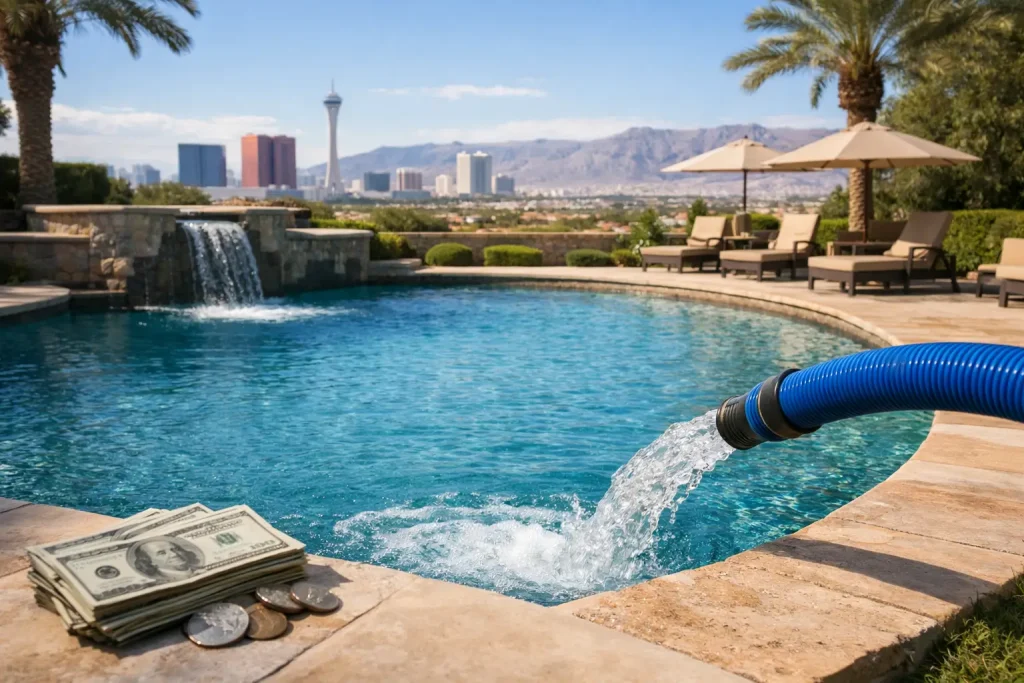
Summer utility bills in Las Vegas can get your attention fast, especially when you are staring at an empty or newly resurfaced pool and wondering how much does it cost to fill a pool in Las Vegas. The short answer is that most homeowners will spend anywhere from a couple hundred dollars to several hundred dollars in water costs, depending on pool size, local water rates, and whether you are filling from a hose, trucked water, or after major repairs.
That broad range is frustrating, but it is also honest. Pool filling costs in Southern Nevada are never one-size-fits-all. The size of the pool matters most, but timing, evaporation, water restrictions, and even the condition of your pool equipment can affect the final number.
How much does it cost to fill a pool in Las Vegas?
For many Las Vegas homeowners, filling a standard residential pool from a municipal water source often lands somewhere around $150 to $500 or more. Smaller plunge pools may cost less, while large custom pools, deep pools, or pools with attached spas and water features can go well beyond that.
A simple way to think about it is by gallons. A modest pool might hold 10,000 to 15,000 gallons. A medium-sized backyard pool may hold 15,000 to 20,000 gallons. Larger residential pools can reach 25,000 gallons or more. Once you apply your household water rate and any tiered usage charges, the price starts to add up quickly.
The challenge is that Las Vegas water bills are not always linear. If filling your pool pushes your home into a higher usage tier for the month, your cost per gallon can increase. That is why two neighbors with similar pools can still end up with different bills.
What affects the cost to fill a pool in Las Vegas?
Pool volume is the biggest factor, but it is not the only one. The final cost depends on how much water the pool holds, how your water utility calculates usage, and whether you are filling a completely empty pool or just topping off after partial draining or repairs.
If your pool has a deep end, oversized spa, tanning ledge, or custom shape, it may hold more water than it appears to at a glance. Homeowners are often surprised by how much capacity a freeform or feature-rich pool actually has.
Water rates matter just as much. In Las Vegas, residential bills can include base charges plus volume-based charges. If a pool fill happens during a month when your landscape irrigation is already high, the cost may be noticeably steeper than expected.
There is also the method of filling. Most homeowners use regular hose water from the home supply. In some cases, especially after resurfacing or a renovation, water delivery by truck may be considered. That can be faster, but it usually comes with its own pricing structure, delivery fees, and scheduling requirements.
Estimated pool fill costs by size
A small pool in the 10,000-gallon range will usually be at the lower end of the price range. A mid-sized pool around 15,000 to 20,000 gallons often lands in the middle. A larger pool over 25,000 gallons can push costs much higher, especially if the fill triggers higher tiered water pricing.
As a rough local reference, many homeowners can expect something like this:
- 10,000 gallons: roughly $100 to $250
- 15,000 gallons: roughly $150 to $350
- 20,000 gallons: roughly $200 to $450
- 25,000+ gallons: roughly $300 to $600+
These are only working estimates, not guaranteed rates. They are best used for budgeting, not for exact billing predictions. If you are planning a drain-and-refill, a remodel, or startup after resurfacing, it helps to build in a little cushion.
Why some pool owners pay more than expected
The most common surprise is not the water itself. It is everything around the fill. If your pool was drained for plaster, pebble, tile, crack repair, or equipment work, there may be strict timing requirements for refilling. Delays can create issues for fresh surfaces, so homeowners sometimes need to fill quickly rather than wait for the cheapest possible timing.
Another factor is water loss during the process. In extreme heat, evaporation starts working immediately. If there is a hidden plumbing leak or a bad valve, you may also lose water before the pool is fully stabilized. That does not just affect your bill. It can also create startup and chemistry problems.
Older pools can be especially tricky. If your shell, skimmer, lines, or equipment have underlying issues, filling an empty pool without a clear plan can become more expensive than anticipated. That is one reason experienced local guidance matters, especially for aging pools in Las Vegas and Henderson.
Filling after resurfacing or remodeling
If you are filling a pool right after resurfacing, the process needs to be handled carefully. New interior finishes often require a continuous fill, meaning the water should not be stopped midway. Interrupting the fill can leave visible lines or affect the appearance of the finish.
That means cost is only part of the decision. You also need to think about timing, water pressure, hose setup, and startup care. A fresh finish is an investment, and it deserves the right first fill.
This is where homeowners often benefit from working with a full-service pool company. If you are already remodeling or restoring the pool, coordinating the fill with the startup process helps protect the finish and keeps the project moving properly. For local homeowners planning updates, Nationwide Pool often helps clients think through not just the renovation itself, but the practical details that follow.
Is it cheaper to top off instead of drain and refill?
Usually, yes, but not always.
If your water chemistry is manageable and the issue is simply normal evaporation, topping off is obviously less expensive than a full refill. In Las Vegas, evaporation is part of pool ownership, especially in the hottest months. Most homeowners add water regularly throughout the season.
But there are times when partial draining or a full drain-and-refill makes sense. High calcium hardness, excessive total dissolved solids, algae problems, or major repair work can make a simple top-off the wrong solution. In those cases, spending more now may save money and frustration later.
This is where an honest inspection matters. If the pool can be corrected without a full drain, that is usually the better path. If not, it is better to know upfront rather than keep spending money on chemicals and temporary fixes.
Can you reduce the cost of filling a pool?
You may not be able to avoid the water bill, but you can make smarter decisions around it.
Start by confirming the actual volume of your pool. Many homeowners are estimating based on old paperwork or rough guesses. If your real gallon count is lower than expected, your budget may improve. If it is higher, at least you can plan accurately.
It also helps to schedule work carefully. If you are combining resurfacing, equipment updates, leak repair, and startup service, it is worth coordinating the sequence so you only fill once. Multiple drain cycles are expensive and unnecessary when the project is planned well.
You can also reduce future refill costs by addressing leaks, improving circulation, and keeping the water balanced. A well-maintained pool loses less water to avoidable problems and tends to need fewer major corrections over time.
When to ask for professional advice
If you are simply topping off a healthy pool, you probably do not need much help. But if you are filling after repairs, resurfacing, or a suspected leak, professional input can save you money.
A trusted pool company can help you estimate gallons, assess whether a drain is actually needed, check for equipment issues, and guide the startup process so your fresh fill does not lead to a second problem. That kind of support matters most when the pool is older or the project is more than routine maintenance.
Las Vegas pools face real wear from heat, hard water, and long swim seasons. A refill may look like a basic utility expense, but it is often tied to the bigger condition of the pool itself. If the fill is happening because your pool needs repairs or an upgrade, the smartest move is to look at the whole picture, not just the monthly bill.
A pool should feel like part of your home, not a source of guesswork. If you are planning to fill, refill, or renovate a pool in Las Vegas, a clear estimate and the right timing can make the process much easier from the start.