
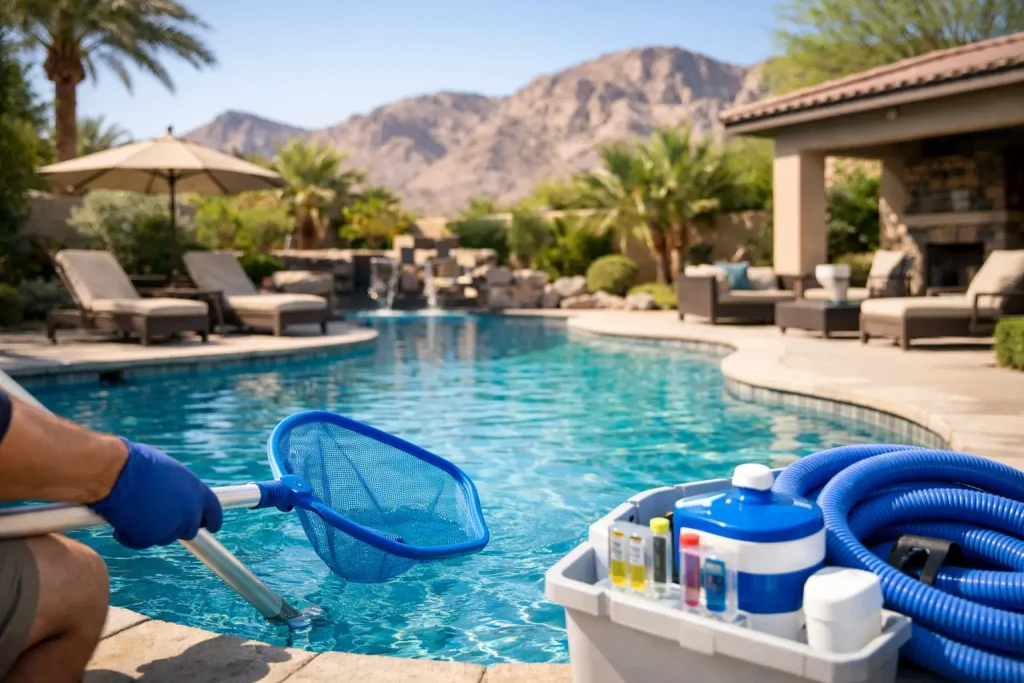
If your pool looks perfect in the morning and slightly off by the weekend, you are not imagining it. A real pool maintenance guide Las Vegas homeowners can trust has to account for intense sun, high evaporation, windblown dust, and heavy summer use. Pools in Southern Nevada do not drift out of balance slowly – they can change fast, and small problems get expensive when they are ignored.
That is why effective pool care here is not just about keeping the water blue. It is about protecting plaster and tile, helping equipment last longer, avoiding algae blooms during heat waves, and making sure your backyard stays ready when you want to use it. Whether you handle the basics yourself or rely on a professional service, understanding how Las Vegas conditions affect your pool helps you make better decisions year-round.
Why pool care is different in Las Vegas
Las Vegas pools deal with a harder environment than pools in milder climates. Summer heat puts water chemistry under constant pressure, while UV exposure burns through chlorine faster than many homeowners expect. Add dust, leaves, and desert debris from windy days, and your filtration system has to work harder than it would in many other parts of the country.
Water loss is another big factor. Evaporation happens quickly here, especially in peak summer, which means your waterline drops and minerals become more concentrated over time. That can lead to scale buildup on tile, cloudy water, and extra wear on heaters, salt systems, and other equipment. If your pool already has an older surface or aging plumbing, these conditions tend to expose weak points sooner.
This is also why a one-size-fits-all routine rarely works. A newer pool with upgraded equipment may need a different maintenance cadence than an older backyard pool with worn plaster, dated pumps, or recurring leak concerns.
A practical pool maintenance guide Las Vegas owners can follow
The most reliable approach is consistent, simple care done on schedule. You do not need to overcomplicate pool maintenance, but you do need to stay ahead of the climate.
Start with circulation. Your pump and filter are the backbone of the entire system, and when they are not running properly, chemistry problems often follow. During hotter months, many pools need longer run times because higher temperatures and heavier use increase the demand on the system. In cooler months, run time can often be reduced, but it still needs to be long enough to circulate the water well and prevent stagnant areas.
Skimming and emptying baskets matter more than they seem. Debris left floating in the water eventually breaks down, affects chemical demand, and can stain surfaces. Full skimmer and pump baskets also reduce efficiency, forcing your equipment to work harder. In a desert climate where dust can build up quickly, that extra strain adds up.
Brushing is another step homeowners often skip, especially when the water looks clean. But brushing walls, steps, and corners helps prevent algae and loosens fine debris before it becomes a bigger issue. If your pool has textured surfaces, older plaster, or shaded sections, brushing becomes even more important.
Vacuuming or using an automatic cleaner helps remove the particles your skimmer misses. This is especially useful after windy days, monsoon activity, or pool parties. Fine desert dust settles fast, and if it sits too long, it can affect both appearance and water balance.
Water chemistry: where most problems start
The biggest maintenance mistakes usually begin with chemistry that is slightly off and stays that way for too long. In Las Vegas, sanitizer levels can drop quickly under direct sun, so chlorine needs close attention. If chlorine falls too low, algae and bacteria have an opening. If the water is consistently overtreated, surfaces and equipment can suffer.
pH is another key factor. When pH runs high, which is common in desert environments, calcium scale becomes more likely. You may start to see buildup at the tile line, reduced water clarity, and stress on equipment. When pH drops too low, water can become aggressive and damage plaster, metal components, and seals.
Calcium hardness and total alkalinity also need to be watched carefully here. Las Vegas fill water can contribute to hardness, and as evaporation increases, those minerals stay behind. Over time, this can create stubborn scaling and shorten the life of heaters and finishes. On the other hand, trying to correct chemistry too aggressively can create swings that are just as problematic.
This is where professional testing and experienced adjustment make a real difference. It is not just about adding chemicals. It is about knowing what the water is doing, what the finish can handle, and how to correct issues without causing new ones.
Seasonal changes still matter in the desert
People often assume pool maintenance is basically the same all year in Las Vegas because pools do not face the kind of winter shutdown seen in colder regions. But the routine still changes by season.
In spring, the focus is usually getting ahead of rising temperatures before heavy swim season begins. This is the ideal time to inspect equipment, clean filters, and correct minor chemistry issues before heat magnifies them. If your waterline tile already has buildup or your plaster is beginning to show age, spring is when those concerns should be addressed.
Summer is the highest-demand season. Pools need more frequent monitoring because chlorine burns off faster, swimmers introduce more contaminants, and evaporation increases sharply. This is also when weak pumps, failing filters, and aging automation systems tend to reveal themselves.
Fall can be deceptively easy. The weather feels milder, so some homeowners ease off too much. But debris, wind, and lingering warm water can still create algae conditions if circulation and chemistry are neglected.
Winter is usually the best time to evaluate the pool itself. If your surface is rough, stained, or cracking, or your deck has become worn and dated, cooler months are often ideal for planning repairs, resurfacing, or larger upgrades before the next swim season arrives.
What homeowners can handle and when to call for help
There is nothing wrong with a hands-on approach if you have the time and want to stay involved. Many homeowners can manage basic skimming, water level checks, visual inspections, and light debris removal. Staying aware of how your pool looks and sounds is valuable because early warning signs are often obvious once you know what to notice.
But there is a difference between routine attention and reliable long-term care. If your chemistry never seems stable, your water clouds up repeatedly, your equipment is noisy, or your surface is becoming rough or discolored, the issue may be larger than weekly maintenance. Trying to patch over those problems with repeated chemical additions usually costs more in the long run.
A professional service becomes especially helpful when your pool is older, your schedule is full, or you want the pool to look consistently guest-ready without the trial and error. An experienced local company can spot leak symptoms, circulation issues, failing components, and finish deterioration before they turn into major repair bills.
When maintenance turns into renovation
Sometimes the best pool maintenance guide Las Vegas residents can follow includes knowing when maintenance alone is no longer enough. If your pool needs constant correction, has persistent stains, rough plaster, cracked decking, outdated tile, or inefficient equipment, you may be putting money into symptoms instead of solutions.
This is common with aging backyard pools across Las Vegas and Henderson. A remodel can improve appearance, but it also solves practical problems. Resurfacing can restore comfort and protect the shell. Updated tile and coping can reduce visible wear. New pumps, filters, and automation can improve efficiency and make regular care easier. Deck restoration can also make the entire outdoor space safer and more attractive.
That full-picture approach matters. A pool should be easy to enjoy, not a source of constant maintenance frustration. Companies with deep local experience, including Nationwide Pool, understand how to combine routine service, repair, and renovation planning so homeowners are not forced to juggle multiple contractors.
Protecting your investment year-round
Your pool is not just a feature in the backyard. For many Las Vegas homeowners, it is one of the most used and most visible parts of the property. It affects how your home feels, how you entertain, and how much you enjoy being outside during a long warm season.
Good maintenance protects more than water quality. It protects surface finishes, energy efficiency, equipment life, and the overall look of your outdoor space. It also gives you better options when it is time to upgrade, because a well-maintained pool is easier to remodel than one that has been neglected for years.
The right routine depends on your pool’s age, condition, equipment, and how often it is used. But the principle stays the same: consistency beats catch-up. When your care plan matches the realities of the Las Vegas climate, your pool stays cleaner, runs better, and remains the kind of backyard investment you actually get to enjoy.